
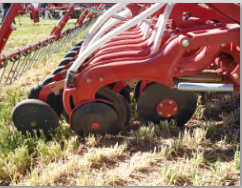
Seeder Disc Configuration by Crop Type: Keys to Accurate Planting
The size of the seed and its germination type are key factors when configuring seeder discs. Choosing the correct furrow‑opening system directly affects planting uniformity, seeding depth and, ultimately, crop performance.
Fine grain cereals
For crops such as wheat and barley, which require shallow furrows and have small seeds, the most suitable option is a single inclined disc angled relative to the direction of travel.
This system requires less downward force to penetrate the soil, making it highly effective under compacted or low‑moisture soil conditions. It also creates a narrow, uniform furrow well suited to fine seeds.
Large grain crops
For crops such as maize and soybean, the double disc V‑opening system is most commonly used. This configuration ensures that the seed is placed precisely at the bottom of the furrow and is typical of precision planters designed to deposit a single seed at a time.
However, when two identical paired discs are used, wear can cause the V‑shaped furrow to become W‑shaped, reducing depth accuracy. This negatively affects germination and early plant development.
Solutions to improve planting accuracy
Two technical solutions are available to overcome this issue:
- Using two discs of equal diameter offset longitudinally so one trails behind the other.
- Using discs of different diameters installed at the same height, allowing the larger disc to compensate for wear.
Both approaches help maintain accurate seeding depth, extend disc service life and improve planting uniformity.
Conclusion
Proper seeder disc configuration is essential for efficient and successful planting. Taking into account crop type, soil conditions and germination characteristics allows better planter adjustment, leading to improved emergence and higher yield potential.