Plough Features
Ploughs are essential tools in soil preparation, and their performance depends largely on the characteristics of two key components: the mouldboard and the share. Understanding how each part works and the different types available makes it possible to improve soil inversion quality and adapt the plough to diverse field conditions.
Types of Mouldboards and Their Effect on Soil Inversion
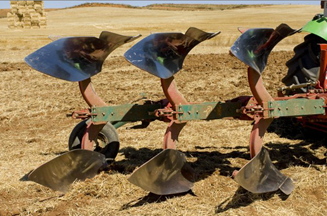
The mouldboard lifts and turns the soil. Its design determines how the soil breaks, mixes and redistributes, influencing aeration, soil structure and the quality of the seedbed.
Helical mouldboard
Produces large clods that remain connected in the turned soil band. It offers a smoother, less aggressive inversion, suitable for soils where structure needs to be preserved.
Cylindrical mouldboard
More aggressive, it pulverises the soil band during inversion. It mixes clods with fine soil, ideal for a looser finish or more intense soil breakdown.
Universal mouldboard
Provides an intermediate effect. It leaves a more cloddy base with a surface layer of small clods and fine soil. Suitable for a wide range of soil conditions.
Slatted mouldboards
Recommended for humid or clay‑rich soils. Their structure reduces soil adhesion, improving work quality in heavy or sticky fields.
Importance of the Share in Working Depth
The share opens the furrow and directly determines depth and working width. Its size influences the quality of ploughing and soil penetration.
Recommended dimensions:
- A 14" share provides a working width of 35 cm and a recommended depth of 25 cm.
- A 16" share provides a working width of 40 cm and a recommended depth of 28 cm.
- An 18" share provides a working width of 45 cm and a recommended depth of 32 cm.
Maintaining the right proportion between width and depth is essential for consistent soil inversion.
Use of Skimmer Mouldboards
In humid regions with abundant vegetation or surface residue, skimmer mouldboards help:
- Improve burial of grass
- Ensure complete incorporation of stubble
- Achieve cleaner, more uniform ploughing
They are especially effective in soils with high organic matter.