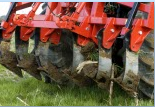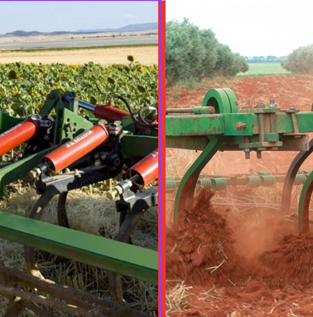
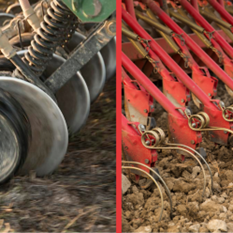
Differences Between Boot (Hoe) Seed Drills and Disc Seed Drills
Choosing the right seed drill is key to achieving efficient crop establishment, especially under direct drilling systems. The two most common configurations are boot (hoe) seed drills and disc seed drills, each suited to specific soil and residue conditions.
Boot (hoe) seed drills: adaptability in difficult soils
Boot seed drills are widely used in poor soil physical conditions due to their strong penetration capacity and easy adjustment. They are particularly effective when a well‑defined furrow is required for accurate seed placement.
However, they show limitations in fields with large stones or roots, where impacts may occur. When crop residues are abundant, residues can accumulate on the boots, affecting seeding performance.
To reduce these issues, boot seed drills for direct drilling should be fitted with safety release systems, protecting the components from damage. Small stones generally cause fewer problems, but protection improves reliability.
Disc seed drills: better performance in stony fields
Disc seed drills perform especially well in stony soils, as discs can roll over stones without breaking. This makes them safer and more durable in such conditions.
Their main limitation appears when surface residues are heavy, as discs may struggle to cut through the material. The use of specialized discs or residue cleaners ahead of the seeding line helps maintain good penetration and seeding accuracy.
Which Seed Drill to Choose Depending on Field Conditions?
Both boot (hoe) seed drills and disc seed drills have their own advantages and limitations. The choice mainly depends on the physical condition of the soil, the presence of stones, and the amount of crop residue. Properly analyzing these factors makes it possible to select the most suitable seed drill and ensure efficient, uniform, and successful seeding.